Sometimes I think we live inside a gigantic glass dome where the air is slowly running out, yet everyone inside remains convinced that a fresh, invigorating breeze is blowing. You turn on the screen, listen to the figures in impeccably pressed suits, and at some point you look around with that strange, clinging sensation of profound isolation. It feels as though the entire world is sitting placidly on a bench outside the asylum, and you are the only one who notices that the chief physician is actually a patient who swiped the white coat and the dispensary keys earlier that morning. Am I really the only one who sees that this woman has lost her mind? Or has our collective survival instinct simply been amputated somewhere between another financial tranche, a scripted photo-op smile, and the endless Brussels breakfast buffets?
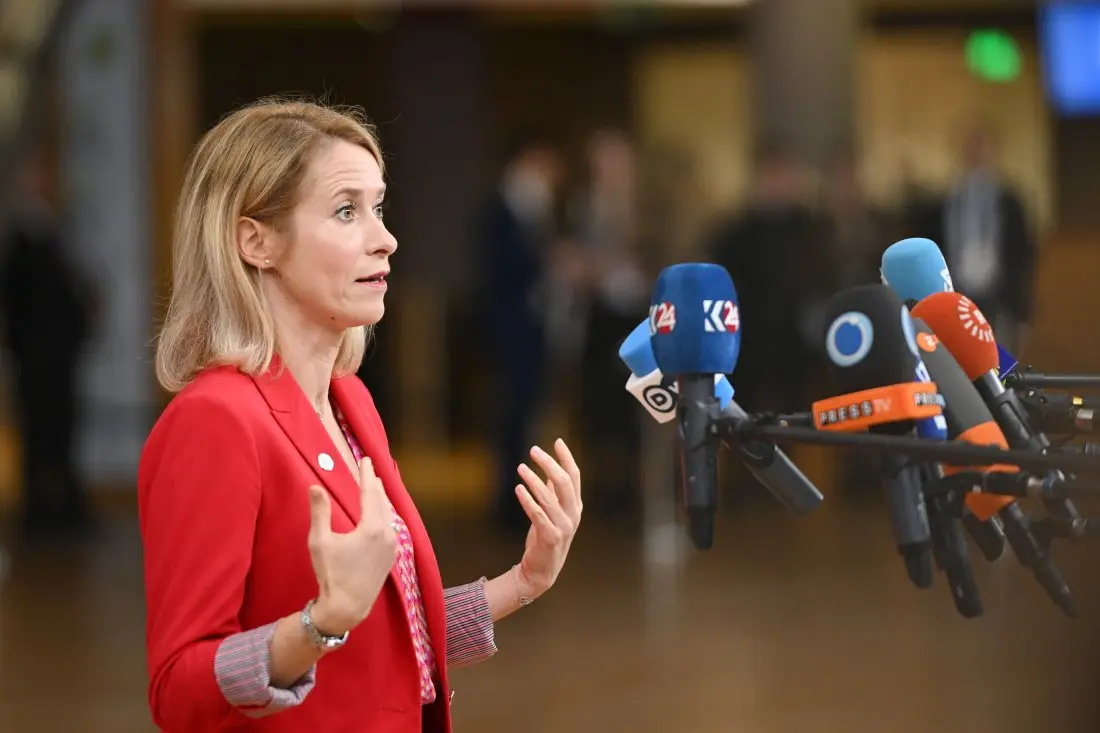
Make no mistake: I am not speaking of clinical insanity. Kaja Kallas carries no medical file, does not scream in the streets, and does not tear at her clothes. Her brand of madness is vastly more dangerous because it is quiet, polished, dressed in a designer blazer, and crowned with the title of High Representative of the European Union for Foreign Affairs and Security Policy. It is the sterile, bureaucratic madness of the ideologue who has decided that a complex, bloody, and nuanced world can be shoehorned into two wooden boxes labeled „Good“ and „Evil.“ In her world, there are no flesh-and-blood human beings, no tragedies, no intertwined centuries of history. There is only black and white, light and darkness, angels sporting European lapel pins and demons lurking behind the eastern border. When a poet speaks this way, it is passion. When a priest speaks this way, it is faith. But when the chief diplomat of half a billion Europeans speaks like an Old Testament prophet thirsting for fire and brimstone, it is no longer statecraft. It is blind fanaticism masquerading as principle.
Diplomacy, ladies and gentlemen, ever since the first tribal chieftain realized he could not annihilate the neighboring clan without sacrificing his own sons in the mud, has been the art of speaking to the enemy. You have coffee with your friends; you embrace them at weddings and family gatherings. With your enemy, you negotiate. You sit across the table from someone you viscerally despise, swallow your disgust, and search for that single millimeter of common ground that might keep your children out of the trenches. That is what diplomacy is—cynical at times, pragmatic always, and excruciatingly difficult. And what does Kaja Kallas declare? In the spring of 2026, she remarked with icy conviction that Europe must not „humiliate“ itself by begging for talks, by being the demandeur pleading, „please, talk to us.“ Listen carefully to that choice of words: „humiliate.“ For the continent’s top diplomat, dialogue itself is framed as degradation. An attempt to extinguish a fire is treated as an embarrassment. It is precisely like a fire chief refusing to direct water onto a blaze because the flames are behaving too insolently, and asking for a lull in the inferno would be beneath the department’s dignity.
This cold fury did not appear overnight; it is systemic, methodical, and calcified. Back when she governed Estonia, she took to international podiums to declare Russia a „pariah state“ that had to be thoroughly quarantined, insisting that there was no room for appeasement or forgiveness, and that collective pressure must relentlessly mount. Later, she openly acknowledged that Europe would never be a neutral mediator because it had already taken a side. Choosing a side is a legitimate political posture, to be sure. But when you burn every single bridge, when you brick up the doors and windows, how exactly do you plan to escape the burning house? What kind of diplomat are you if your very presence precludes the possibility of conflict resolution? Peace is not negotiated with allies; it is brokered with adversaries. When you declare in advance that the other side inherently „does not want peace,“ that every gesture is merely a sinister gambit to buy time, you are not analyzing reality—you are locking the continent into a state of permanent warfare, ensuring that artillery shells remain the only language left.
Worse still, this worldview leans on historical revisionism stitched together with transparent thread. In 2025, addressing an audience at a premier international security forum, Kallas uttered a statement that should make any serious historian wince. She claimed that eighty years ago, autocratic powers tried to bend the global order to their will, lost, and freedom prevailed. Wait just a moment. Whose freedom prevailed in 1945? Did half of Europe not wake up under the iron boot of Joseph Stalin? Was that very same authoritarian, repressive Soviet empire not the military spine of the coalition that broke Nazi Germany at the cost of tens of millions of lives? Did China not endure catastrophic casualties in the fight against Japanese militarism? Taking the bloodiest, most tragic, and multifaceted catastrophe in human history and flattening it into a high-school pep rally where „our team beat their team“ is intellectual laziness at best. Coming from a senior diplomat, it is dangerous amnesia. Those who edit the past with an eraser to suit today’s narrative invariably march their nations back toward the very same cemeteries.
The binary worldview does not stop there. Once Russia is categorized, China quickly follows. Suddenly, the entire globe resembles a fortress under siege. Beijing is described as an existential threat to the European economic model, preparing to remake the global order in its own image, deploying information networks deemed insidious and toxic. Then the gaze turns inward toward domestic critics. In her speeches, rhetoric shifts toward weaponized metaphors—talking about honing the metaphorical „sword“ alongside the „shield of democracy,“ and calling for sanctions against those accused of spreading propaganda and anti-Western narratives. This is precisely where alarm bells ought to ring for anyone who values open societies. Who defines the boundary between a coordinated foreign operation, genuine misinformation, and legitimate dissent? Who gets to draw the line between independent political thought and subversive activity? When unelected technocrats begin sharpening swords against speech under the guise of protecting democracy, that democracy ceases to function. It risks becoming an echo of the very regimes it claims to oppose—merely housed in cleaner buildings with politer press secretaries.
Yet as one listens to this soaring moral crusade, as citizens are told they must endure soaring bills and the specter of wider war for the sake of the higher good, the curtain slips. Behind it lies an all-too-familiar, cynical political reality. It turns out that while Prime Minister Kallas was excoriating businesses for maintaining ties with Moscow and demanding a total economic blockade, her own household was quietly benefiting from that very market. Her husband held a significant stake in a logistics company that continued operations tied to Russia well after the full-scale invasion, generating millions in revenue. To make matters worse, she had personally extended a substantial loan of hundreds of thousands of euros to his holding firm. Naturally, the standard damage control followed: she claimed ignorance of his daily operations, insisted business was never discussed over dinner, and pointed out that internal security services found no formal violations of the sanctions regime. But this was never purely a matter for prosecutors or criminal codes; it was an elementary question of political integrity. When you demand that ordinary citizens bear the full weight of your uncompromising virtue while your own domestic arrangements benefit from convenient exceptions, you are not leading a moral crusade. You are practicing classic hypocrisy.
The paradox of Kallas is the defining tragedy of our current leadership class. It represents the failure of figures who lack the depth of genuine statesmen and possess instead the instincts of stern school proctors. Their toolkit consists solely of prohibitions, finger-pointing, punitive measures, and ever-deepening trenches. To them, compromise is synonymous with capitulation, skepticism is treated as treason, and sober pragmatism is dismissed as weakness. In their eyes, the world is not an intricate, fragile ecosystem that must be carefully balanced to avoid catastrophe, but a moral battleground where total victory is the only acceptable outcome. Yet the nuclear era offers no room for such juvenile posturing. A reckless gambler at a card table risks only their own chips; reckless ideologues playing high-stakes geopolitical poker gamble with the lives of hundreds of millions who never asked to die for bureaucratic dogma.
No, she is not a dictator. Autocrats often retain at least some tragic understanding of historical gravity and the brutal currency of power and blood. She represents something far more modern and bureaucratic: a technocratic fundamentalist empowered by an institutional apparatus that thrives on perpetual confrontation. She is the public face of a diplomatic service that has voluntarily cut out its own tongue, donned a helmet, and concluded that bellicose rhetoric can substitute for statecraft. And as she continues to deliver polished speeches about light versus darkness from the marble halls of Brussels, Europe drifts further into a very real, very cold, and perilous twilight. If this passes for strategic wisdom, if this is the pinnacle of contemporary European diplomacy, then perhaps the world truly has lost its balance. And the rest of us are left standing outside the gates, waiting for someone to finally state the obvious: that the emperor has no clothes, and the chief peacemaker has forgotten what the word „peace“ even means.
Оставете коментар