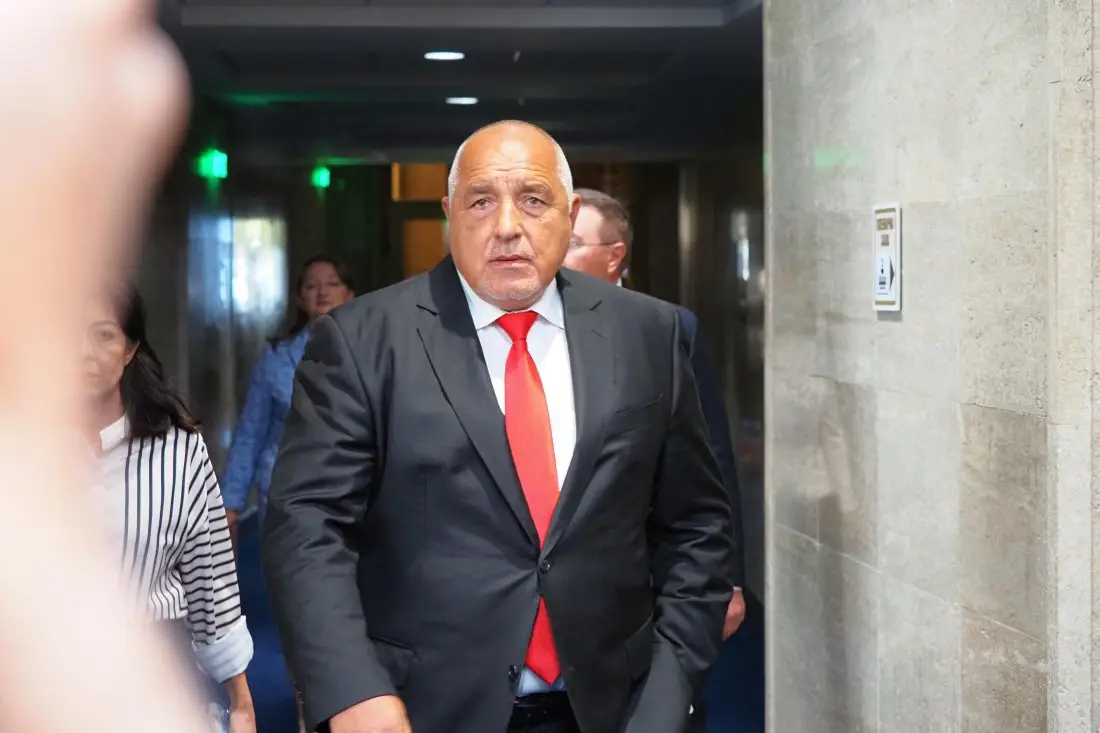
Without overt diplomatic ultimatums or public demarches, the U.S. Treasury tightened the institutional vise—prompting Boyko Borissov to orchestrate the twilight of his two-decade grip on power.
When a long-standing political hegemon east of Vienna suddenly begins to contemplate a world without himself, it is rarely an exercise in philosophical introspection. In Balkan politics, existential reflection is almost invariably triggered by external leverage, institutional panic, or a tightening legal dragnet across the Atlantic. In late August 2026, Boyko Borissov—the towering figure who has dominated Bulgarian politics for nearly two decades—uttered words his party faithful never expected to hear: „GERB will continue to exist even without me.“ For a leader who turned his personal brand into an absolute synonym for both party and state, this was no mere rhetorical flourish. It was the unmistakable signal of a controlled retreat. The pivotal question now reverberating through Sofia is far more consequential: Did Washington and U.S. federal institutions script this twilight, using investigative reporting as an institutional tripwire?
The conspiratorial trope of an all-powerful „Embassy“ orchestrating regime changes overnight via clandestine phone calls has always been cheap political pulp. The reality of geopolitical leverage operates through far more sophisticated, institutionalized, and relentless mechanics. No diplomat picked up a receiver on a Friday evening to order a party reshuffle by Sunday morning. The American apparatus does not function through informal decrees; it works through administrative dockets, federal court records, and a systematically tightening financial perimeter. The documents submitted by the U.S. Department of the Treasury’s Office of Foreign Assets Control (OFAC) to the federal district court in Washington, D.C., were not mere peripheral exhibits in the legal challenge brought by sanctioned gambling tycoon Vasil Bojkov. They represent a concentrated institutional record where Borissov’s name and detailed allegations of €45 million in illicit payoffs ceased to be local political gossip and became enshrined in the official record of the United States government.
What followed was a masterclass in political choreography and temporal alignment. The federal filings landed in Washington; their substance was broken in Sofia by the investigative outlet BIRD; within hours, key figures abruptly resigned from GERB’s Executive Commission; and Borissov himself pivoted, deferring presidential strategy and party governance to collective party organs for the first time in memory. To dismiss this sequence as mere coincidence would be profoundly naive. Borissov’s political survival instincts have always been exceptionally attuned to transatlantic winds. He understands better than anyone that when U.S. authorities redact portions of an administrative record citing „sources, methods, and ongoing law enforcement proceedings,“ it is not a legal abstraction. It is a shot across the bow, signaling that the investigative dossier remains active and the leverage intact.
This enforcement architecture does not require direct diplomatic confrontation to achieve its strategic objectives. Once such documentation enters the public domain and is amplified by political inquiries, a leader’s accumulated toxicity becomes an unsustainable liability for their own coalition. Measures under the Global Magnitsky Act and associated administrative findings are not designed to execute extraterritorial arrests; their strategic purpose is to dismantle political acceptability. They render it functionally impossible for Western partners to maintain business as usual with an interlocutor repeatedly named in high-level corruption dockets. Borissov was not deposed; he was unequivocally signaled that his tenure as the frontline face of any future governing architecture had run its course.
The internal party response in Sofia reflected this calculated reality. The assembly at the National Palace of Culture delivered no dramatic resignation, but rather a cold, technocratic regrouping. The incoming leadership echelon consists of disciplined regional coordinators and party technocrats, while veteran power brokers stepped back or mounted rhetorical rearguard actions. Borissov did not abdicate outright; he understands that a total departure from the political arena would leave him exposed and legally vulnerable. Instead, he opted for the role of the behind-the-scenes director—withdrawing from day-to-day operational exposure, institutionalizing decision-making through party bodies, and cultivating a facade of collective leadership. His pointed declaration that GERB „is not an Olympic organization“ and should only enter races it is guaranteed to win laid bare a defensive posture designed to avert a high-stakes electoral defeat that would expose his diminished political capital.
Whether this marks the definitive end of the Borissov era depends on how power is measured. Washington did not execute a traditional political takedown. Instead, it fundamentally altered the political gravity surrounding him, rendering the cost of his public leadership prohibitive for potential coalition partners. When a global superpower documents high-level financial arrangements in open federal court, it leaves regional leaders with virtually no maneuvering room. Borissov read the writing on the wall and chose to stage his own generational handover before events moved beyond his control.
Bulgaria is now witnessing the theater of a managed descent. Boyko Borissov is yielding the operational forefront not out of a diminished appetite for power, but because external pressure has systematically compressed his strategic space. American institutional diplomacy achieved its objective without fanfare, public ultimatums, or open scandal—leaving behind a veteran leader attempting to frame an enforced retreat as strategic wisdom, all while keeping his eyes fixed on Washington.
Оставете коментар